
Is it cheaper to grind or remove a stump?
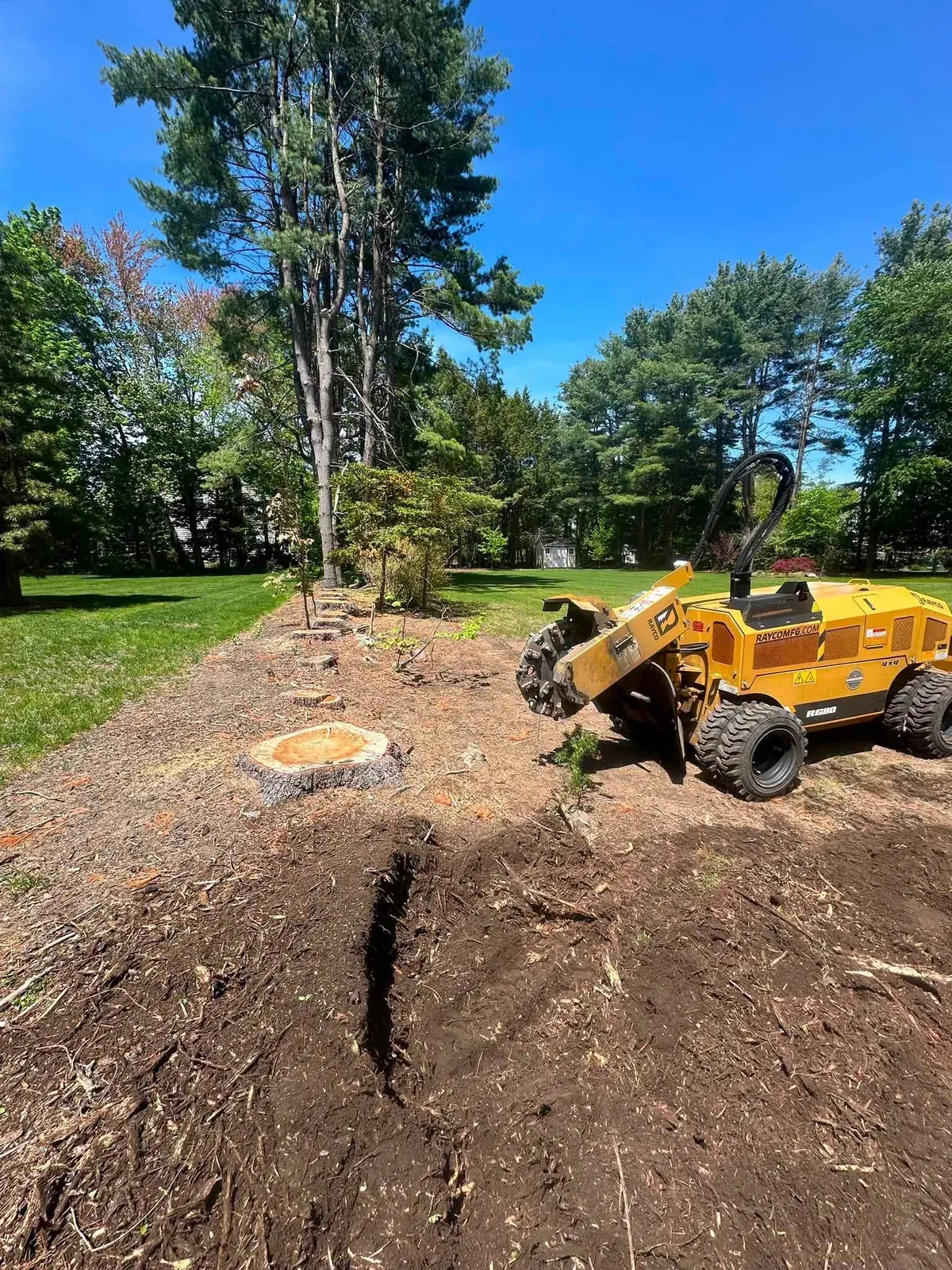
In most yards, grinding is cheaper than full stump removal. Angi puts grinding at about $170 to $500 and says removal typically costs $100 to $200 more. Removal also leaves a much bigger hole to fill and regrade, so the gap grows once you count the yard repair.
Full removal still makes sense in a few cases. The rest of this post shows when, and what each method really costs.
Grinding vs. removal at a glance
Grinding and removal solve different problems. Grinding chews the stump into chips below the surface and leaves the deeper roots to break down. Removal pulls out the stump and root ball with a machine or by hand.
| Stump grinding | Full removal (digging out) | |
|---|---|---|
| National cost range | $150 to $500 (HomeAdvisor) | $200 to $700 (HomeAdvisor) |
| What stays in the ground | Deep roots | Little or nothing |
| Hole left behind | Small, filled with chips or soil | Up to 12 feet wide or more (HomeGuide) |
| Yard damage | Low | Higher, from heavy equipment |
| Replant a tree in the same spot | No | Yes |
| Typical depth | 4 to 6 inches below ground (Angi) | Full root ball |
All figures are national reference ranges from published cost guides. They are not our prices.
What each method costs
The four common ways to get rid of a stump, with published national ranges:
| Method | Reported cost per stump | Source |
|---|---|---|
| Grinding | $150 to $500 | Angi, HomeAdvisor |
| Manual or machine removal | $200 to $700 | HomeAdvisor, Fixr |
| Chemical rotting | $60 to $200, takes several weeks | HomeAdvisor |
| Burning | $100 to $200 | HomeAdvisor |
One guide looks different. HomeGuide lists digging at $80 to $190 per stump, but adds that contractors charge a $150 to $350 minimum to operate a backhoe. For one or two stumps, that minimum usually erases the savings. Once you add hauling the root ball and refilling the hole, digging rarely comes out ahead.
Burning also brings its own rules. Many towns restrict open burning, so check with your local fire department before you consider it.
The hidden costs of full removal
The price to pull a stump is only the start. Full removal leaves work behind.
Filling the hole. A dug-out stump can leave a crater many feet across. HomeGuide notes that removal takes a lot of topsoil to level the yard.
Regrading and seeding. Heavy equipment compacts and tears up turf around the hole. You may need new sod or seed over a wider area. Fixr lists sod at $0.30 to $0.83 per square foot.
Hauling the root ball. A large root ball with soil attached is heavy and awkward. Disposal is often a separate charge.
Damage risk. HomeGuide lists larger damage risks as a downside of removal. Big roots can wrap around irrigation lines, walkways and buried utilities, and pulling them can drag those along too.
Grinding has extras as well, but they are smaller. Cleanup or chip hauling can be a separate line item. HomeGuide lists it at $2 to $4 per inch when charged separately. Grinding surface roots across the lawn also adds time. HomeGuide puts root removal at $75 to $150 per hour.
When grinding is the right call
Grinding is the better value in most residential situations:
- You want a lawn or garden bed in that spot. HomeGuide says grinding 6 to 8 inches down is enough to plant grass.
- The stump is near a house, patio, fence or driveway. Grinding disturbs far less soil than digging.
- You have several stumps. Additional stumps in the same visit cost much less than the first. HomeGuide reports $30 to $60 each.
- The yard is finished and you want to keep it that way. A small patch of loam and seed is easier than repairing a crater.
Our stump grinding cost calculator shows how this adds up. At our calculator’s reference rates, one 24-inch hardwood stump with easy access comes to $150 (the visit minimum, since 24 x $5 is $120). Five 24-inch hardwood stumps come to $510 after the calculator’s 15% multi-stump reduction. These are planning figures, not quotes.
When full removal is worth paying for
Removal earns its higher price in a few situations:
- You plan to plant a new tree in the same spot. Grinding leaves roots that block a new root ball.
- You are building over the spot. Footings, additions and some patios need the root mass out so nothing is built over decaying wood.
- You are clearing a lot. On a building site with many stumps, excavating stumps as part of land clearing can be more efficient than grinding each one.
For a single stump in a finished yard, these cases are uncommon.
A rule to know near water in New Hampshire
If your stump is close to a lake, pond or protected river, the cheaper option may not be either one. Under New Hampshire’s shoreland law, stumps and their root systems in the 50-foot waterfront buffer must be left intact in the ground unless removal is approved by NH DES (RSA 483-B:9). Stumps that are removed must be replaced with pervious surfaces, new trees or other woody vegetation.
That means a waterfront stump may need to be cut low and left in place. This is guidance, not legal advice. If your stump is near the water, ask the town or NH DES before any work, and send us a photo that shows the shoreline.
What about leaving the stump alone?
Doing nothing is free up front. HomeAdvisor notes that a stump can take 10 years to several decades to decay on its own. In the meantime it gets in the way of mowing and can sprout new shoots.
The bottom line
For most homeowners, grinding costs less, takes less time and leaves the yard in better shape. Full removal costs more and leaves a big hole, but it is the right choice when you need to replant a tree or build in that spot.
Learn more about our stump grinding service, or see what changes a job locally in Goffstown, Manchester or Bedford. When you are ready, call (603) 438-6492 or request a quote. Tell us how many stumps you have, how big they are and what you plan to do with the spot, and we will tell you which approach fits.
Related questions
How much more does full stump removal cost than grinding?
Angi reports stump grinding at about $170 to $500 and says full removal typically costs $100 to $200 more. HomeAdvisor and Fixr both list manual removal at $200 to $700 per stump. These are national reference ranges.
Can I plant a new tree where a stump was ground?
Not right on top of it in most cases. HomeGuide notes that grinding leaves the root system in the ground, so you cannot replant a new tree over the same spot. Grass, garden beds and small plants are fine once the hole is filled with soil.
Will the roots grow back after grinding?
Some can. HomeGuide notes that grinding does not stop sprouting from some hardy underground roots, so a few species may send up shoots that need cutting back.
Is chemical stump removal cheaper than grinding?
The products cost less, but the process is slow. HomeAdvisor lists professional chemical rotting at $60 to $200 and says it can take several weeks.
Can I remove a stump near a lake or river in New Hampshire?
Often not without approval. Within the 50-foot waterfront buffer of protected waters, RSA 483-B:9 requires stumps and their root systems to stay intact in the ground unless NH DES approves removal. Ask before any grinding or digging near the water.